
.jpg?upscale=true&upscale=true&width=560&name=banner_careerbird%20(1).jpg) |
We have some great new features to share this month that make it easier to proactively manage hundreds or thousands of roles at your organization. |
| Required skills
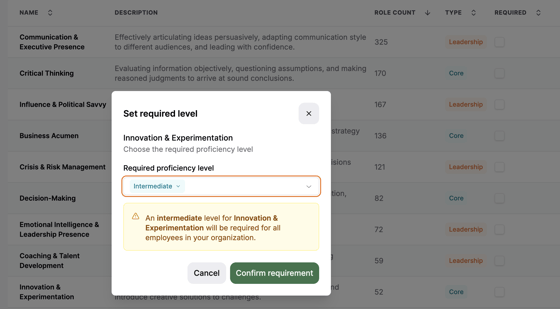
This feature may seem small, but it has big implications. Organizational admins and job family admins can now mark skills as required for the entire organization or all roles in a specific job family. Skills marked as required will automatically appear on every role profile, along with existing and company-specific learning resources. New skills may be added, and existing skills can be edited before marking as required.
Are there specific core competencies HR would like to prioritize as part of an organization-wide employee upskilling initiative? Are there role-specific technical skills that your engineering, sales, customer success, or other functions want to make sure employees are building? Do you want to drive the adoption of AI across the company or specific functions? Required skills can help you make it happen.
Click here to explore core skills and role-specific skills
|
 |
| Revision tracking and version history
To make it easier for managers to suggest changes and for HR admins to approve them, redline revision tracking is now available. This includes edits to the title, level, description, responsibilities, and role-based, core, and leadership skills.
Each time a job is updated and approved, a version history is created, allowing admins to see how roles have evolved and what was changed when and by whom.
This workflow introduces governance and transparency into role design, ensuring that changes are intentional, reviewable, and aligned with business needs. |
.png?upscale=true&upscale=true&width=560&name=Screenshot%202026-01-22%20at%203.56.41%20PM%20(1).png) |
|
| Job families and job tracks
Organizational admins can now give specific people permission to add and edit roles, create job tracks, update skills, and curate learning resources. Job families group roles by shared skills, responsibilities, and areas of expertise, creating a structured framework for organizing roles and career paths across the organization.
Job tracks show progression of responsibilities, skills, and proficiency from entry-level roles to senior and leadership positions, helping employees understand what career growth looks like.
This makes career progression more transparent, supports development planning, and helps employees see concrete advancement pathways within the organization.
Job Families | Job Tracks | Roles |
.png?upscale=true&upscale=true&width=560&name=Screenshot%202026-01-30%20at%206.29.51%20PM%20(2).png) |
|
| Job posting templates
Now, Career Bird can act as a single source of truth for all of your job descriptions, including ones for internal use and external posting. The new job posting template capability allows HR admins to create templates that combine standard boilerplate text (company description, benefits, EEOC statement, apply instructions) with role-specific information (responsibilities, skills, education, experience, and salary ranges).
The templates can be used by recruiters to create job postings based on the already approved role descriptions. The resulting job description can be easily exported to your ATS or directly to job boards.
Contact support@careerbird.ai if you would like to turn this functionality on. |
.png?upscale=true&upscale=true&width=560&name=image%20(13).png) |
|
| Job leveling 2.0
Job leveling has new capabilities! Every job level has a visible description of the level, which may include criteria such as scope, autonomy, impact, and skill level. In addition to the Career Bird default levels (IC 1-8 and Manager 1-8), clients can create their own or use Radford, WTW, and other leveling systems. The number of levels can be easily customized based on organization size. |
.png?upscale=true&upscale=true&width=560&name=image%20(14).png) |
|
| Manager dashboard with team insights
The Manager Dashboard has been expanded to provide deeper insight into team progress and development. In addition to the role review workflow, managers can now see skill survey completion, proficiency distribution, and role alignment metrics at a glance. The dashboard also surfaces growth opportunities and skill gaps across the team, making it easier to prepare for 1:1s, performance conversations, and development planning.
|
.png?upscale=true&upscale=true&width=560&name=Screenshot%202026-01-20%20at%206.42.45%20PM%20(1).png) |
|
| Compensation benchmarks (beta)
The new compensation feature features public market compensation insights that benchmark roles against real-world data. It shows a base salary range, percentile benchmarks (25th, 50th, 75th, and 90th), and breakdowns by company size, global and U.S. region, and U.S. metro tiers.
These insights allow HR and People teams to ground-level decisions in market reality, identify geographic adjustments, and make more informed compensation conversations with leadership, directly within the same system where roles and responsibilities are defined. |
.png?upscale=true&upscale=true&width=560&name=Screenshot%202026-01-22%20at%203.57.52%20PM%20(1).png) |
|
| Success metrics (beta)
Success Metrics are now included in every role, defining how performance is measured for each role through clear, outcome-based indicators. Unlike responsibilities, which outline what someone does, success metrics focus on the measurable results that define strong performance.across these dimensions: Business & Outcome Impact, Execution & Reliability, Collaboration & Influence, helping organizations connect roles directly to business outcomes.
This gives managers a consistent framework for evaluating performance and enables employees to better understand what success looks like in their role.
|
.png?upscale=true&%20Annuity%20Insurance%20Company%20(1).png&upscale=true&%20Annuity%20Insurance%20Company%20(1).png?upscale=true&%20Annuity%20Insurance%20Company%20(1).png&width=560&name=Role%20Description%20_%20Americo%20Financial%20Life%20%26%20Annuity%20Insurance%20Company%20(1).png?upscale=true&%20Annuity%20Insurance%20Company%20(1).png&upscale=true&%20Annuity%20Insurance%20Company%20(1).png?upscale=true&%20Annuity%20Insurance%20Company%20(1).png) |
|
On the product roadmap
Exciting new features in the works
|